Mobile game creative testing means running ad variations against each other to find the ones that bring the most valuable players. Set up tracking first, test new concepts and hooks before small details, change one thing at a time, wait for enough installs to trust the result, and judge winners on IPM, retention and ROAS, not cost per install alone.
Set up tracking before you spend
Without install and event attribution you cannot tell which creative brought valuable players. Connect your ad networks to analytics, and to an MMP if you buy from more than one network, before the first test goes live. At minimum, track installs, tutorial completion, day 1 return and the first purchase or rewarded ad view.
The numbers that decide a creative test
| Metric | Formula | What it tells you |
|---|---|---|
| IPM (installs per mille) | installs ÷ impressions × 1,000 | How well the ad turns views into installs. The main early signal |
| CTR | clicks ÷ impressions | Whether the hook stops people scrolling |
| CPI / eCPI | spend ÷ installs | What the install cost. Depends on the auction as much as the ad |
| D1 / D7 retention | returning players ÷ installs | Whether the ad attracted the right players |
| ROAS D7 | revenue by day 7 ÷ spend | Whether those players pay |
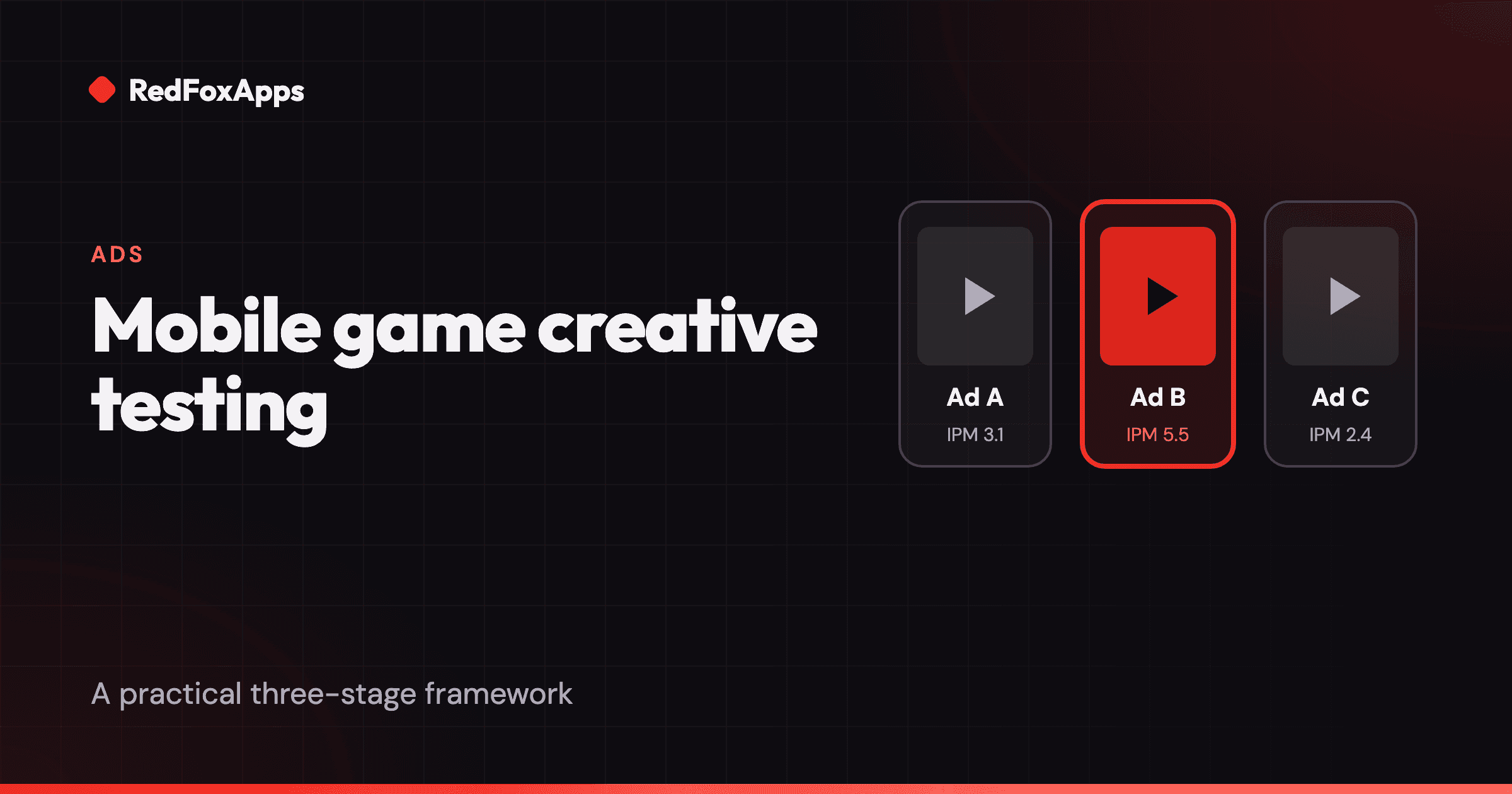
IPM example. A video gets 80,000 impressions and 320 installs. IPM = 320 ÷ 80,000 × 1,000 = 4.0. A second video gets 60,000 impressions and 330 installs: IPM 5.5. The second creative converts better, even though it had fewer impressions.
IPM is a better first filter than CPI because it measures the ad itself. CPI moves with bids, audience and time of day.
A three-stage testing framework
| Stage | What you test | How many variants | When to move on |
|---|---|---|---|
| 1. Concept | Different ideas: gameplay, fail-and-retry, satisfying moments, character story, UGC-style | 3 to 5 very different ads | One or two concepts clearly beat the rest on IPM |
| 2. Hook | The first 3 seconds of the winning concept | 3 to 6 openings, same body | A hook wins on IPM and holds on D1 retention |
| 3. Iteration | Text overlay, length, end card, music, colour, aspect ratio | 2 to 4 small changes | Gains get small; go back to stage 1 with new concepts |
Most of the gain comes from stages 1 and 2. Changing the button colour on a weak concept rarely saves it.
Test the hook first
Most viewers decide in the first few seconds. Once you have a concept that works, keep the gameplay body the same and try different openings:
- A failure the viewer wants to fix ("only 1% can solve this")
- The most satisfying moment of play, shown first
- A near-win that cuts off
- A real person reacting to the game
- A clear before and after
Change one variable at a time
In stages 2 and 3, change one thing per variant. If you change the hook, the music and the end card together and the ad improves, you do not know why, and you cannot repeat it.
Give tests enough data
Small samples give confident-looking but wrong answers. One analysis of IPM sampling found that with only 20 installs, the true IPM could be about 40% lower or 50% higher than what you observed. At around 400 installs the range narrowed to roughly ±10%.
Practical rules:
- Agree the budget and stopping point before the test starts.
- Aim for at least 100 installs per variant before you call a concept test, more for small differences.
- Run tests for at least a few full days, so weekday and weekend behaviour both count.
- Do not stop a test early because one ad looks good on day one.
How to decide a winner
Once each variant has enough installs, read IPM and early retention together:
| What you see | What it usually means | What to do |
|---|---|---|
| Higher IPM, D1 retention the same or higher | A real winner | Scale it and test new hooks on it |
| Higher IPM, lower D1 retention | The ad promises more than the game delivers | Do not scale. Match the ad to real gameplay |
| Similar IPM, higher D1 retention | The ad attracts better players | Keep it, and test hooks to lift IPM |
| Lower IPM and lower retention | A loser | Stop it and test a new concept |
Use ROAS at day 7 as the final check on the winners, because it shows whether those players pay.
Video vs playable ads
Playable ads let people try a mini version of the game inside the ad. Liftoff's mobile ad creative reporting found playables averaging a higher IPM than video in gaming (about 4.8 vs 2.9). That comparison pools many different campaigns, though, so it is not a controlled test.
Before you build playables, weigh the cost. They can take one to two weeks and several thousand dollars to make, and they only run at scale on some networks, mainly the big in-app ad networks such as AppLovin and Unity. On Meta and TikTok, short vertical video still does most of the work. Start with video, find a winning concept, then turn that concept into a playable.
Creative testing for a game running seasonal events
The question we get most often is how to test creatives when a game runs seasonal events, such as a winter event or a Halloween update. The window is short, so you cannot run a slow test cycle during the event itself.
A setup that works:
- Find winners on evergreen creative first. Run your normal concept and hook tests in the weeks before the event. Seasonal themes should go on top of proven concepts, not replace them.
- Make a seasonal version of each winner. Same hook and structure, new theme: a winter skin, seasonal music, an event end card. Production stays cheap and the test stays clean.
- Pre-test one to two weeks before the event. Run the seasonal versions against their evergreen originals at small budget. If the seasonal version wins on IPM and holds D1 retention, it is ready.
- Scale during the event, and refresh fast. Creatives tire quickly in busy seasonal auctions. Have two or three variants of each seasonal winner ready to rotate in.
- Switch back on time. Pull seasonal ads when the event ends. A Halloween ad in mid-November tells players the game is stale.
- Tie the store page to the ad. Update screenshots or in-app event cards in the store for the event, so the click lands on what the ad promised. See ASO.
Read results beyond installs
A cheap install is only good if the player stays. Compare creatives by retention and by how fast spend is paid back, not by eCPI alone. Some ads win installs by promising something the game does not deliver. Those players leave on day 1, and the "winning" ad loses money.
Where to run creative tests
- Meta and TikTok. Fast learning on short vertical video. Use each platform's built-in split testing, or a separate test campaign with equal budgets per ad.
- Google App campaigns. You supply text, images and videos, and Google tests different combinations of those assets and serves the best performers. Use the asset reports to see which ones get served, and replace the low performers. See Google's About App campaigns.
- In-app ad networks (AppLovin, Unity, Mintegral and others). The main home for playables and end cards.
- Apple Ads. Search ads use your store listing, so here you test store pages, not videos. Apple's custom product pages allow up to 70 additional versions of your product page per app, each with its own URL, screenshots, promotional text and app previews.
Common creative testing mistakes
- Testing small details before finding a strong concept.
- Picking winners on CPI alone.
- Ending tests after one day.
- Running the same creative for months without a refresh.
- Showing gameplay that does not match the real game.
Need help setting this up? See our ads and user acquisition service.
Sources
- Liftoff mobile ad creative report, summary (Mobile User Acquisition Show)
- What is IPM? Mobile game IPM benchmarks and test sample sizes (Playio)
- Custom product pages (Apple Developer)
- About App campaigns (Google Ads Help)