Sudoku is a logic puzzle played on a 9×9 grid split into nine 3×3 boxes. Some numbers are given. You fill the empty cells so that every row, every column and every 3×3 box contains the digits 1 to 9 exactly once. No maths is needed, and a well-made puzzle can always be solved by logic, without guessing.
Sudoku looks like a maths puzzle, but it is really a logic puzzle. The digits could be letters or colours and the game would work the same way. You never add or subtract anything. You only work out which digit can go where.
The rules of Sudoku
The grid has 81 cells, arranged in 9 rows, 9 columns and 9 boxes of 3×3 cells. Some cells already contain a digit. These are the givens (or clues).
Fill every empty cell so that:
- Each row contains the digits 1 to 9 exactly once.
- Each column contains the digits 1 to 9 exactly once.
- Each 3×3 box contains the digits 1 to 9 exactly once.
That is all. A properly made Sudoku has exactly one solution, so every digit can be worked out from the givens.
Sudoku words you will see
| Word | Meaning |
|---|---|
| Cell | One square of the grid |
| Row, column | A horizontal or vertical line of 9 cells |
| Box (or block) | One of the nine 3×3 squares |
| Unit | Any row, column or box. Each must contain 1 to 9 once |
| Givens | The digits printed at the start. They never change |
| Candidates | The digits that could still go in an empty cell |
| Pencil marks | Small notes of candidates written in a cell |
| Peers | The 20 other cells that share a row, column or box with a cell |
A worked example
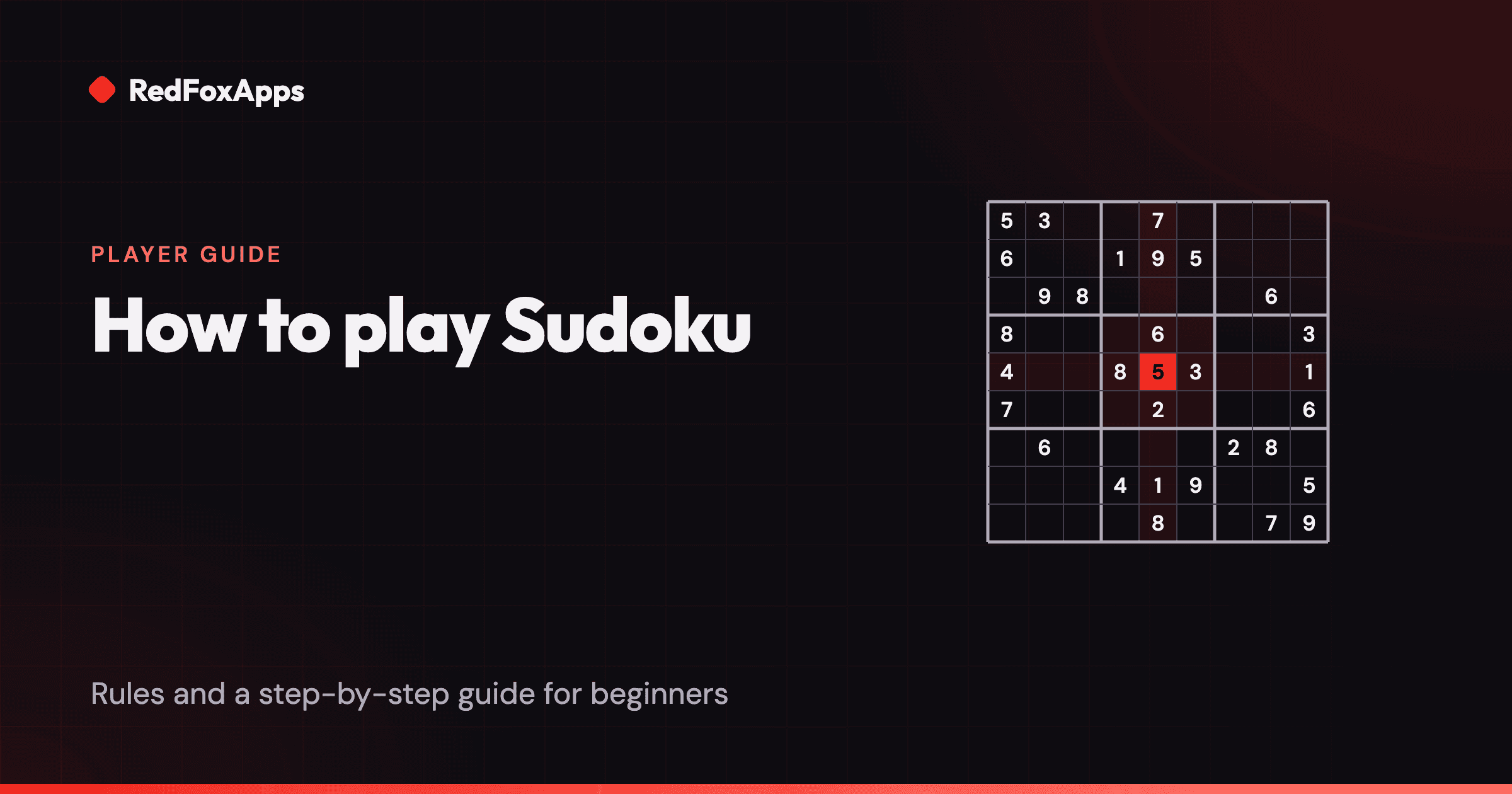
Take the puzzle in the picture at the top of this page and look at the centre cell of the grid (row 5, column 5). Ask which digits its peers already use:
- Row 5 contains 4, 8, 3 and 1.
- Column 5 contains 7, 9, 6, 2, 1 and 8.
- The centre box contains 6, 8, 3 and 2.
Together those are 1, 2, 3, 4, 6, 7, 8 and 9. The only digit missing is 5, so the centre cell must be 5. That is the whole idea of Sudoku: rule out what cannot go in a cell until one option is left.
How to solve your first Sudoku, step by step
Step 1: Scan for one digit at a time
Pick a digit that already appears many times in the grid, for example 8. For each box that is missing an 8, look along the rows and columns that pass through that box. Any row or column that already has an 8 rules out the cells it crosses. If only one cell in the box is left, the 8 goes there. This is called scanning or cross-hatching, and it solves most of an easy puzzle.
Work through the digits 1 to 9 this way, then go round again. Every digit you place opens up new chances.
Step 2: Finish nearly full units
Look for a row, column or box with only one or two empty cells. Count which digits are missing. If only one is missing, write it in. If two are missing, check each empty cell against its column or row to see which digit fits where.
Step 3: Check single cells
When scanning stops working, pick an empty cell and list the digits its row, column and box already contain, as in the worked example. If eight digits are ruled out, the ninth is the answer. This is called a naked single.
Step 4: Use pencil marks
On medium and harder puzzles you will reach a point where no single digit is obvious. Write the possible candidates in small numbers in each empty cell. Then, every time you place a digit, erase it from the pencil marks of its peers. Cells with only one candidate left are solved. Patterns in the pencil marks lead to the techniques in our Sudoku strategies guide.
Step 5: Never guess
If you feel you need to guess, you have missed a logical step. Guessing leads to errors that only show up many moves later. Go back to scanning, check nearly full units, or look for pairs in your pencil marks instead.
Sudoku difficulty levels
| Level | What you need |
|---|---|
| Easy | Scanning and naked singles. Many givens |
| Medium | Pencil marks, hidden singles and pairs |
| Hard | Pointing pairs, triples and box/line reduction |
| Expert | Advanced patterns such as X-Wing, Swordfish and Y-Wing |
The number of givens is not the main thing that sets difficulty. The techniques the puzzle forces you to use are. Mathematicians have shown that a Sudoku with a single solution needs at least 17 givens, yet some 17-clue puzzles are easy and some 30-clue puzzles are very hard.
10 Sudoku tips for beginners
- Start with the digit that appears most often. It usually has the fewest places left.
- Scan boxes, then rows, then columns. Switching direction shows placements you missed.
- Fill in what you are sure of, nothing more. One wrong digit can wreck the whole grid.
- Use pencil marks early on harder puzzles. Waiting until you are stuck wastes time.
- Update pencil marks every time you place a digit. Stale marks cause most mistakes.
- Look for cells with two candidates. They are the start of most medium techniques.
- Check each unit for a digit that fits only one cell. That is a hidden single, and it is easy to miss.
- Take a break when stuck. Fresh eyes spot what tired eyes skip.
- Move up one level at a time. Each level teaches one or two new techniques.
- Play daily. Short regular sessions build pattern recognition faster than long ones.
Common beginner mistakes
- Placing a digit because it "looks right" rather than because nothing else can go there.
- Forgetting the box rule and checking only the row and column.
- Writing pencil marks but not removing candidates after placing a digit.
- Guessing to finish faster.
Play Sudoku on your phone
Minimal Sudoku is our free Sudoku game for Android. It has a clean, distraction-free grid, notes, hints when you need a nudge, lives, levels from easy to expert, and global leaderboards. Start on easy, use the steps above, and move up a level when you can finish without hints.
Sources
- Sudoku (Wikipedia)
- There is no 16-clue Sudoku: solving the Sudoku minimum number of clues problem (arXiv (McGuire, Tugemann, Civario))