The core Sudoku strategies, in order, are scanning, naked singles and hidden singles for easy puzzles; pencil marks, naked and hidden pairs, pointing pairs and box/line reduction for medium and hard puzzles; and X-Wing, Swordfish and Y-Wing for expert puzzles. Apply the simplest technique that works, then go back to scanning after every new digit.
Every Sudoku can be solved by logic, but harder puzzles need more than one kind of logic. This guide lists the techniques in the order you will meet them. Learn them one level at a time. If you are new to the game, start with how to play Sudoku.
Techniques at a glance
| # | Technique | Level | What it does |
|---|---|---|---|
| 1 | Scanning | Easy | Places a digit that fits only one cell of a box |
| 2 | Naked single | Easy | A cell with only one possible digit |
| 3 | Hidden single | Easy | A digit with only one possible cell in a unit |
| 4 | Pencil marks | Medium | Records candidates so patterns become visible |
| 5 | Naked pair | Medium | Two cells, two candidates: removes them elsewhere |
| 6 | Hidden pair | Medium | Two digits confined to two cells: clears other candidates |
| 7 | Pointing pair | Hard | A box's candidates in one line clear that line |
| 8 | Box/line reduction | Hard | A line's candidates in one box clear that box |
| 9 | Naked and hidden triples | Hard | The pair ideas with three cells and three digits |
| 10 | X-Wing | Expert | A rectangle pattern across two rows or columns |
| 11 | Swordfish | Expert | The X-Wing idea across three rows or columns |
| 12 | Y-Wing | Expert | Three two-candidate cells that trap a digit |
| 13 | Chains and colouring | Expert | Follows one digit through linked cells |
A unit is any row, column or 3×3 box. Candidates are the digits that could still go in a cell.
Easy techniques
1. Scanning (cross-hatching)
Choose one digit. For each box that does not yet contain it, follow the rows and columns that already contain that digit through the box, and rule out the cells they cross. If one cell is left, the digit goes there. Scanning digit by digit, 1 to 9, solves most easy puzzles.
2. Naked single
Pick an empty cell and list everything already in its row, column and box. If eight different digits appear, the ninth is the answer. It is called "naked" because the answer is the only candidate left in the cell.
3. Hidden single
Now look at it the other way round. Pick a unit and a digit it is missing. If only one cell in that unit can take the digit, it goes there, even if that cell still has other candidates. Hidden singles are the technique beginners miss most often.
Medium techniques
4. Pencil marks
From medium level up, write the candidates in every empty cell. After you place a digit, remove it from the pencil marks of every cell in the same row, column and box. Accurate pencil marks are what make every technique below possible, and most mistakes come from forgetting to update them.
5. Naked pair
If two cells in the same unit both have exactly the same two candidates, those two digits must go in those two cells, in some order. So no other cell in that unit can contain either digit.
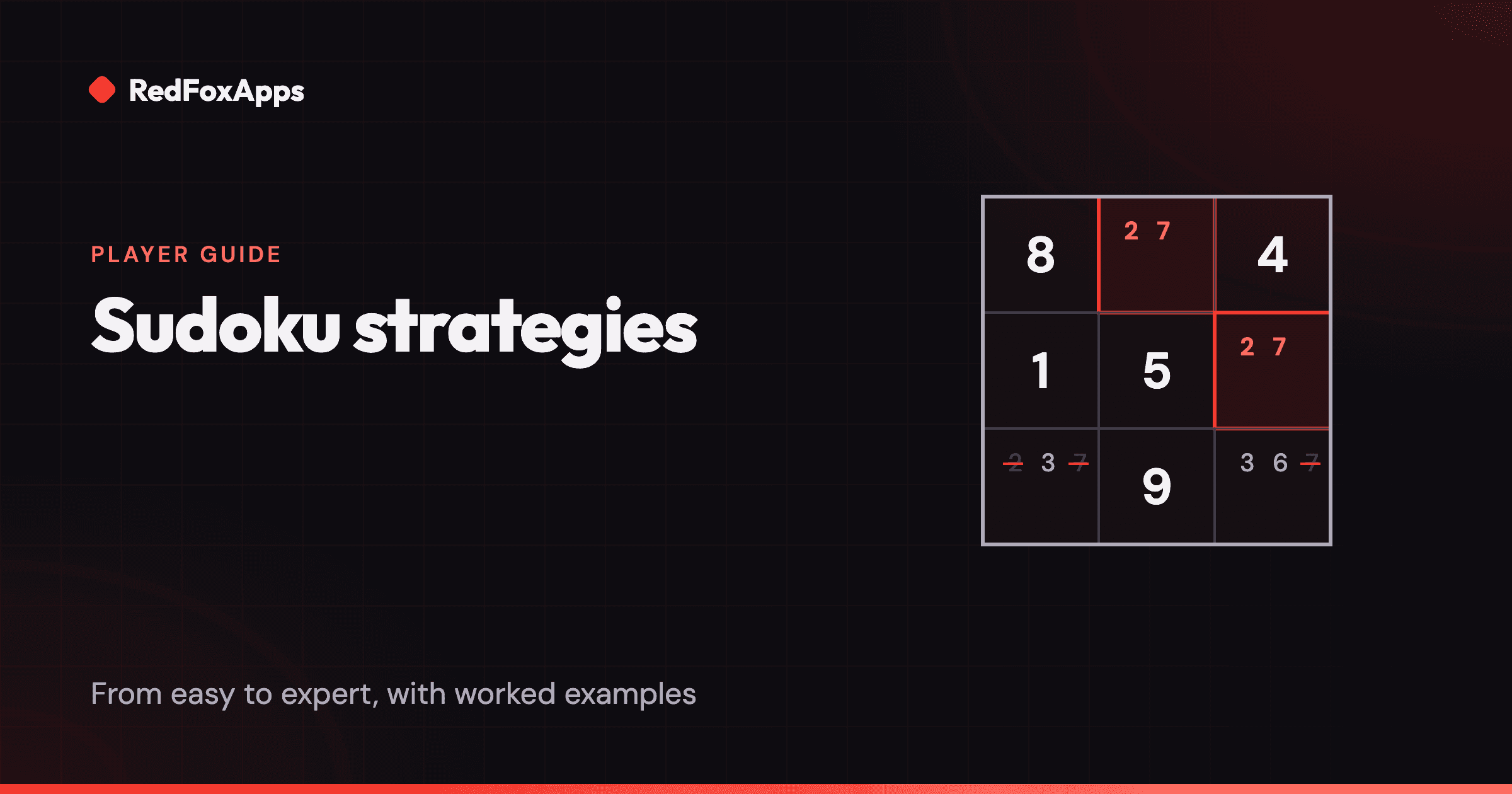
Worked example (the box in the picture at the top of this page). The box already contains 8, 4, 1, 5 and 9, so it needs 2, 3, 6 and 7 in its four empty cells. Two of those cells can only be 2 or 7. That pair uses up the 2 and the 7, so you can remove 2 and 7 from the other two cells:
- The cell with candidates 2, 3, 7 becomes 3.
- The cell with candidates 3, 6, 7 loses the 7, and since the 3 is now taken, it becomes 6.
One pattern, two digits placed.
6. Hidden pair
If two digits can go in only the same two cells of a unit, those cells must hold those two digits. Remove every other candidate from those two cells. A hidden pair often turns into a naked pair once you clean it up.
Hard techniques
7. Pointing pair (locked candidates)
If, inside one box, all the candidates for a digit sit in the same row (or column), then that digit must go somewhere in that row inside the box. So remove that digit from the rest of the row outside the box. With three cells it is a pointing triple, and the logic is the same.
8. Box/line reduction (claiming)
This is the reverse. If, in one row (or column), all the candidates for a digit fall inside the same box, the digit must be in that part of the row. Remove the digit from the other cells of that box.
9. Naked and hidden triples (and quads)
The pair logic extends to three cells. If three cells in a unit contain only three digits between them, for example {1,4}, {4,7} and {1,7}, those digits are locked into those cells. Remove them from the rest of the unit. A hidden triple is three digits that appear in only three cells of a unit, so other candidates in those cells can go. Quads work the same way with four, but they are rare.
Expert techniques
10. X-Wing
Look for a digit that has exactly two possible cells in each of two rows, with those cells in the same two columns. The four cells form a rectangle. The digit must go in one pair of opposite corners, and either way it fills both columns. So you can remove that digit from every other cell in those two columns. The same works with columns and rows swapped.
11. Swordfish
A Swordfish is an X-Wing across three rows. If, in three rows, a digit's candidates are limited to the same three columns (two or three per row), the digit must occupy those three columns within those rows. Remove it from the other cells of those three columns.
12. Y-Wing (XY-Wing)
Find a pivot cell with exactly two candidates, X and Y. Then find two pincer cells that each share a unit with the pivot: one with candidates X and Z, the other with Y and Z. Whatever the pivot turns out to be, one of the pincers must be Z. So any cell that sees both pincers cannot be Z.
13. Chains and colouring
For a single digit, link cells where the digit has only two possible positions in a unit: if one is not the digit, the other must be. Colour the links in two alternating colours. If two cells of the same colour share a unit, that colour is false everywhere, and the other colour is true. Longer chains combine this idea across several digits, and they solve the hardest puzzles without guessing.
A solving routine that works
- Scan every digit, 1 to 9.
- Check nearly full units and hidden singles.
- Fill in pencil marks.
- Look for naked and hidden pairs, then pointing pairs and box/line reduction.
- After every placed digit, go back to step 1. Simple techniques reopen after each placement.
- Only reach for X-Wing, Swordfish or Y-Wing when nothing simpler works.
When you are stuck
- Re-check your pencil marks. A missing or stale candidate hides patterns.
- Count each digit across the grid. The digits with seven or eight placed are the fastest to finish.
- Look at cells with two candidates. Pairs, Y-Wings and chains all start there.
- Step away for a minute. It works more often than it should.
Practise on your phone
Minimal Sudoku is our free Sudoku game for Android, with notes for pencil marks, hints, lives and levels from easy to expert. Play on medium to practise pairs and pointing pairs, then move to hard and expert when you can finish without hints.
Sources
- Sudoku solving algorithms (Wikipedia)
- Sudoku (Wikipedia)