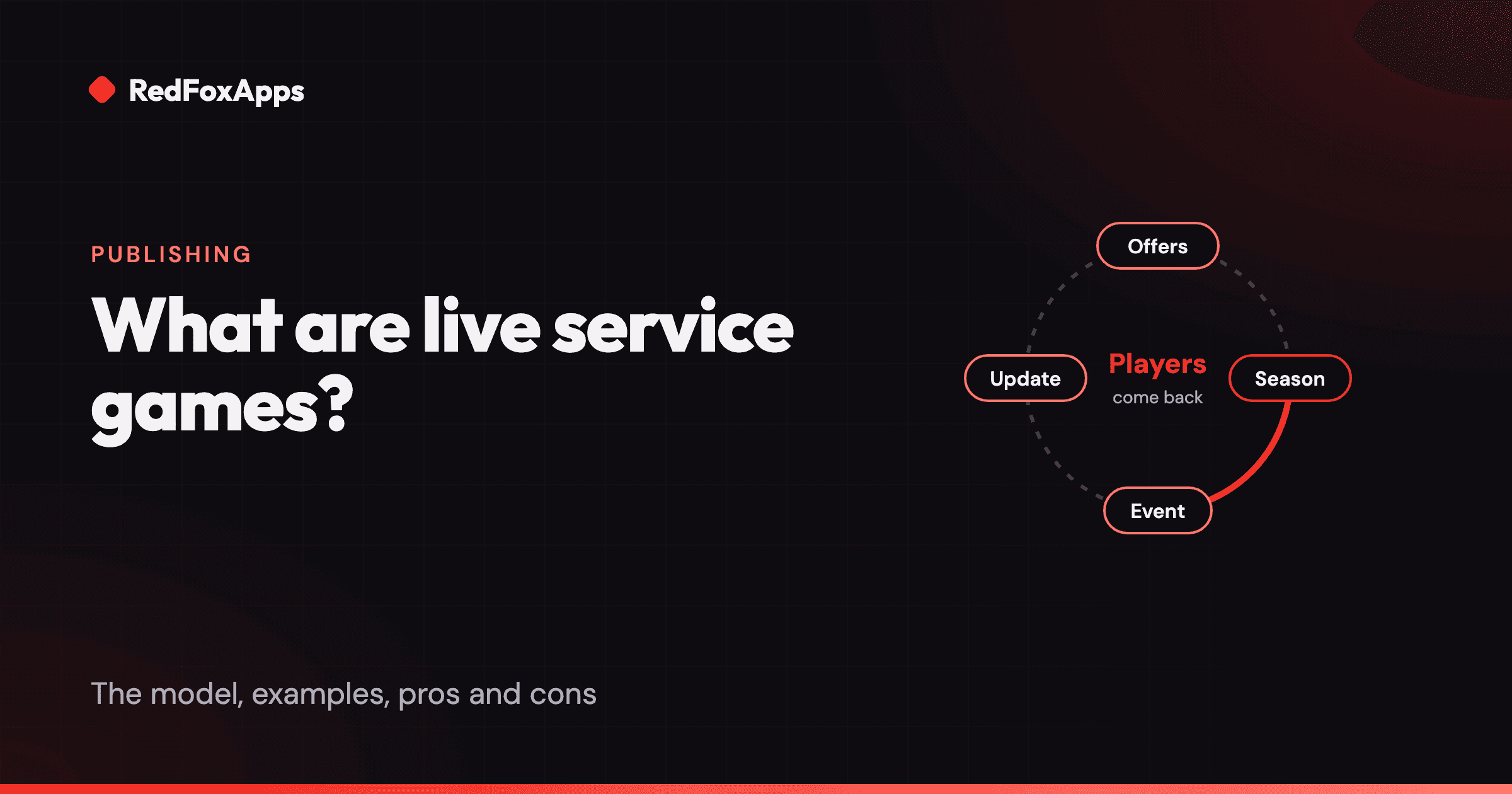
A live service game, also called games as a service, is designed to run for years after launch. The studio keeps adding content through seasons, events and updates, and usually earns through in-app purchases, battle passes or subscriptions rather than one up-front price. Fortnite, Genshin Impact and Clash of Clans are examples.
A live service game is a game designed to keep running, and keep earning, for years after launch. Instead of selling a finished product once, the studio treats the game as a service: it ships seasons, events and new content on a schedule, and players pay over time through in-app purchases, battle passes or subscriptions. You will also see the model called games as a service, or GaaS.
Most of the biggest games of the last decade work this way, on mobile, console and PC. So do many of the most expensive failures.
What makes a game a live service game?
There is no official checklist, but live service games usually share most of these traits:
- Ongoing content. New maps, characters, modes or story arrive on a regular rhythm, often in numbered seasons.
- Timed events. Limited-time challenges and rewards give players a reason to log in this week, not just someday.
- Recurring monetization. Battle passes, cosmetics, in-app currency, gacha draws or subscriptions instead of, or on top of, a one-time price.
- Always online. Accounts, progress and often play itself live on the studio's servers.
- A social layer. Clans, guilds, squads, leaderboards and trading keep players connected to each other.
- Data-driven tuning. The team watches player behaviour and adjusts balance, prices and content.
The day-to-day work of running all this is called LiveOps. The two terms overlap but are not the same: LiveOps is the work, live service is the business model and the game design built around it. A small puzzle game can run LiveOps events without being a live service game in the console-industry sense.
Live service vs traditional games
| Traditional (premium) game | Live service game | |
|---|---|---|
| How players pay | Once, up front | Over time: free or low entry price, then passes, cosmetics, currency or subscriptions |
| Content after launch | Patches, maybe a few expansions | A planned stream of seasons, events and updates |
| Team after launch | Mostly moves to the next project | Large team stays on for years |
| Revenue shape | Spike at launch, then a long tail | Lower at launch, can grow for years if players stay |
| Main risk | Selling enough copies at launch | Not keeping enough players long enough to pay for the team |
| Key metrics | Units sold, review scores | Retention, DAU, ARPDAU, LTV |
What are examples of live service games?
On mobile, the model is the norm rather than the exception:
- Clash of Clans and Clash Royale (Supercell): regular balance changes, seasons and events have kept them running for many years.
- Pokémon GO (Niantic): built around real-world events, community days and limited-time research.
- Genshin Impact (HoYoverse): free to play, with regular version updates that add regions, characters and story, paid for through gacha.
On console and PC:
- Fortnite (Epic Games): the best-known example of seasons and a battle pass, with frequent collaborations and live in-game events.
- Destiny 2 (Bungie): expansions plus seasonal content on a yearly cycle.
- Helldivers 2 (Arrowhead and Sony): a co-op shooter with a running community war. Reports say it sold over 12 million copies across PS5 and PC in about 12 weeks, one of the biggest live service launches of recent years.
How do live service games make money?
Most live service games are free or cheap to start, so revenue comes later and from a minority of players. The common models, often combined:
| Model | How it works | Watch out for |
|---|---|---|
| Battle pass / season pass | A free and a paid reward track that resets each season | Needs a steady supply of rewards players actually want |
| Cosmetics | Skins, emotes and decorations with no gameplay advantage | Only works if players care how they look to others |
| In-game currency and bundles | Gems or coins sold in packs, often with starter and limited-time offers | Price changes and offers affect ARPPU quickly |
| Gacha | Random draws for characters or items | Regulated or restricted in some countries; disclose odds |
| Subscriptions | Monthly perks such as daily currency or ad removal | Players expect clear, lasting value each month |
| Rewarded ads | Players watch an ad for a reward | Revenue depends on eCPM and how often players watch |
On mobile, many smaller games mix the last two with light purchases. That blend of simple gameplay, progression and both ads and in-app purchases is what the industry calls hybrid-casual, and it is a scaled-down cousin of the live service model.
Why do so many live service games fail?
Because players only have so many hours, and the games that already hold them are hard to dislodge. A live service game is not competing with other new releases. It is competing with the few games each player already plays every week.
The clearest recent example is Concord, Sony's hero shooter. It launched in August 2024 to very low player numbers, and Sony took it offline about two weeks later. Sony's leadership later said, in effect, that it entered a crowded segment without standing out enough. Industry coverage linked its failure to the cancellation of other live service projects, and Sony has since delayed Bungie's Marathon.
The common causes of failure:
- No clear reason to switch. The game is a competent version of something players already have.
- Content that runs out. The team cannot produce new content as fast as players consume it.
- Monetization that feels hostile. Aggressive prices or pay-to-win systems drive players away and attract bad press.
- Launching too big, too late. Years of development with no real player data, then a single all-or-nothing launch.
What are the pros and cons of the live service model?
For studios, the pros:
- Revenue can keep growing for years instead of peaking at launch.
- Constant player data shows what to build next.
- A loyal community markets the game for you.
For studios, the cons:
- High fixed costs: servers, a content team, community and support, every month.
- The game can never really be finished.
- Failure is expensive and public, because you have to commit to years of content before you know if players will stay.
For players, live service games can mean a game that improves for years and a free way in. They can also mean pressure to log in, spending that adds up, and a game that disappears when the servers shut down.
How do the numbers work?
A live service game lives or dies on how long players stay and what they spend while they are there. The core equation is simple: LTV is roughly ARPDAU multiplied by the number of days a player stays active.
A worked example. A free-to-play game earns $0.10 per daily active user. The average player is active on 20 days before leaving. LTV is about $0.10 × 20 = $2.00. If a new season lifts the average to 30 active days, LTV becomes $0.10 × 30 = $3.00, a 50% increase without any change to prices. That is why live service teams obsess over retention: adding days is usually easier than raising spending.
Three other numbers tell a live service team whether a season worked:
- Stickiness. The DAU/MAU ratio shows how many of the month's players come back on a given day. A season that works pushes it up.
- Cohorts. Cohort analysis compares players who installed before and during a season, so you can see whether new content changed behaviour or just brought old players back for a week.
- Payer share. The share of active players who pay, together with ARPPU, shows whether revenue grew because more people paid or because the same people paid more.
Should a small mobile studio make a live service game?
Not a big one. The full live service model, with seasons, multiplayer and a large content team, needs a budget most small studios do not have.
But most of its useful parts scale down well: a simple event calendar, a few limited-time offers, regular small content drops and a habit of reading the data. That is LiveOps, and it works for games of almost any size. Start there, see if players respond, and grow the plan with the audience.
If you want a partner to run that side of your game, see our publishing service, or read the mobile game publishing guide.
Sources
- Games as a service (Wikipedia)
- The failure of Concord highlights the flaws of the live service gold rush (Siliconera)