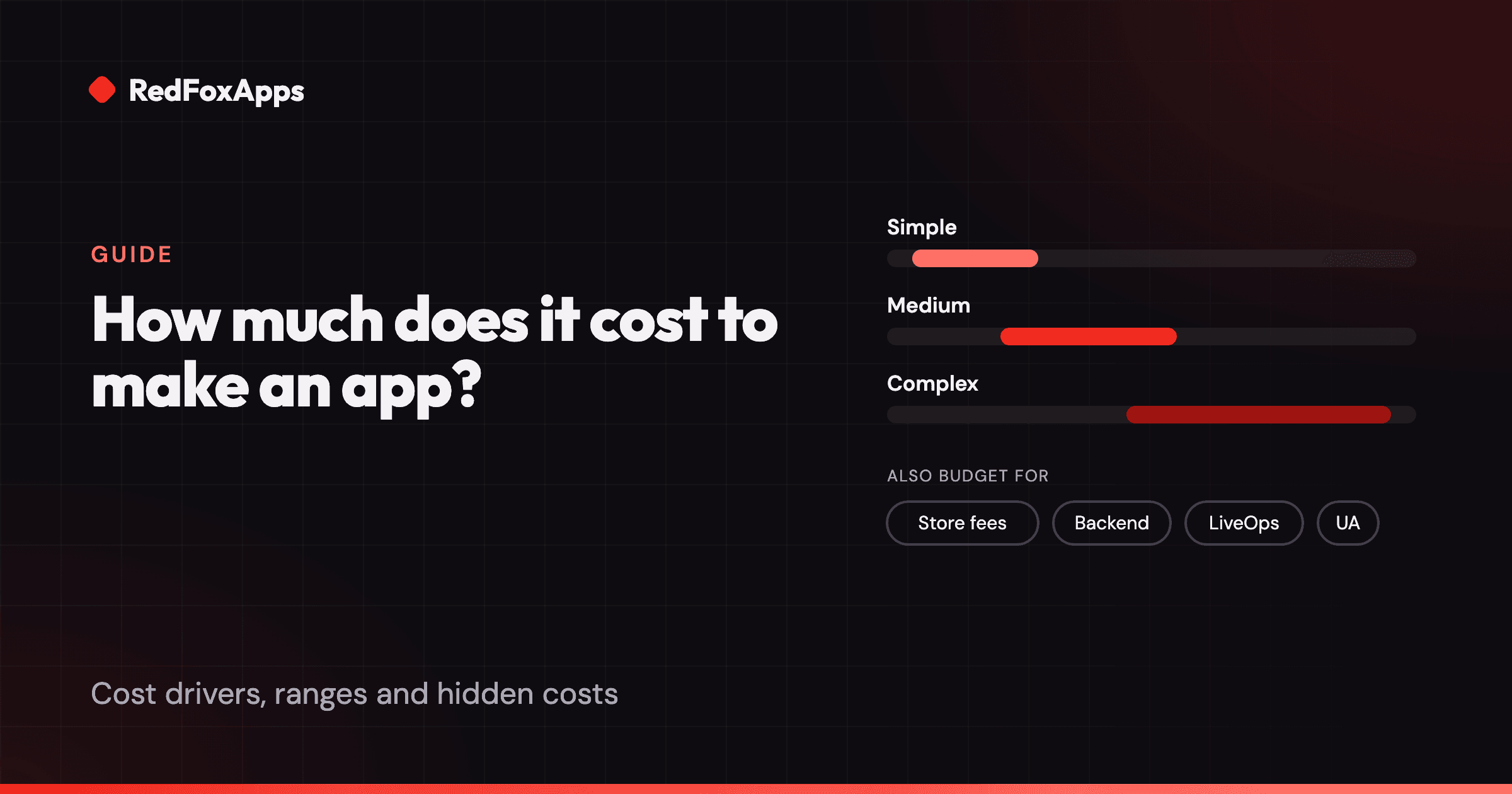
Most estimates put a simple app at about $15,000 to $50,000, a medium app at $50,000 to $150,000 and a complex app at $150,000 to $300,000 or more. Games vary more, because art, content and LiveOps add cost. Store fees, backend, user acquisition and maintenance come on top.
Most published estimates put a simple mobile app at roughly $15,000 to $50,000, a medium app at $50,000 to $150,000, and a complex app at $150,000 to $300,000 or more. Mobile games follow the same logic but vary even more, because art, content and LiveOps can cost as much as the code.
Those ranges come from development agencies, mostly in the US and Europe, and they disagree with each other. Treat them as a starting point for a conversation, not a price list. This guide explains what drives the number up or down, what people forget to budget for, and how to spend less without shipping something worse.
How much does it cost to make an app?
Here is how published 2026 estimates group app projects. We have combined several agency guides, so each band is a range across sources rather than a single figure.
| Complexity | What it usually means | Typical range reported |
|---|---|---|
| Simple | A few screens, no accounts or a simple login, little or no backend, one platform or a cross-platform build | about $15,000 to $50,000 (some quote as low as $5,000 or as high as $60,000) |
| Medium | User accounts, a custom backend, payments or subscriptions, third-party integrations, both platforms | about $50,000 to $150,000 |
| Complex | Real-time features, heavy backend, multiplayer, custom animation, strict security or compliance | about $150,000 to $300,000, and more for enterprise work |
Agency guides also tend to agree on two rules of thumb:
- Maintenance costs about 15% to 20% of the original build every year: OS updates, SDK updates, bug fixes and store policy changes.
- Cross-platform frameworks such as Flutter or React Native are often estimated at 30% to 40% cheaper than building two native apps, although the saving shrinks if you need a lot of native features.
How much does it cost to make a mobile game?
There is no reliable average for games, because "a mobile game" covers everything from a one-mechanic tap game to a multiplayer strategy game with years of content. Rather than quote a number nobody can defend, here is what moves the budget:
- Art and animation. A minimalist puzzle game might need a few hundred assets. A character-driven RPG needs thousands, plus animation and effects. Art is often the largest line in a game budget.
- Content volume. Levels, characters, items and events all have to be designed, built and balanced. More content means more people for longer.
- Multiplayer and servers. Real-time multiplayer adds networking code, servers, anti-cheat and ongoing hosting costs. A single-player game with cloud saves is far cheaper.
- Monetization systems. Ads, in-app purchases, a store, offers and a season pass each need building, testing and tuning.
- Engine and tools. The engine licence is usually small next to salaries. See Godot vs Unity for mobile games if you are still choosing.
The biggest difference between apps and games is what happens after launch. A game needs new content and events to keep players, which means the team keeps working. Budget for LiveOps from day one.
What drives the cost of an app or game?
Almost every quote comes down to hours × hourly rate. These are the things that change the hours or the rate:
- Features. Every screen, integration and edge case adds hours. Cutting features is the single biggest lever you have.
- Platforms. iOS only, Android only, or both. Two native apps cost close to twice as much; a cross-platform build costs less.
- Design. A standard UI kit is cheap. Custom illustration, animation and motion design are not.
- Backend. Accounts, data sync, payments, admin panels and APIs all live on a server that someone has to build and run.
- Team location. Agency guides commonly quote $100 to $250 an hour in the US and roughly half that for teams in Eastern Europe, with lower rates again in other regions. Quality varies within every region.
- Who builds it. Freelancers cost less per hour but need more management. Agencies and studios cost more but bring project management, QA and design.
A worked example: estimating a small game
Here is how the arithmetic works. These numbers are illustrative, not a quote.
A two-person team plans a single-player puzzle game for iOS and Android, built once in Unity:
| Work | Hours |
|---|---|
| Prototype and core loop | 120 |
| Levels and content | 200 |
| Art and UI | 180 |
| Ads, in-app purchases, analytics | 80 |
| QA on real devices | 70 |
| Store listing and launch | 30 |
| Total | 680 |
At an illustrative blended rate of $50 an hour, 680 × $50 = $34,000. At $100 an hour, the same work costs $68,000. Then add 15% to 20% a year for maintenance, which is about $5,100 to $6,800 a year at the lower rate.
Notice what is missing: user acquisition and LiveOps. For a free-to-play game, those can cost more than the build itself.
What hidden costs do people forget?
These rarely appear in a development quote, but you will pay them:
- Developer accounts. Apple's Developer Program has an annual membership fee, and Google Play charges a one-time US$25 registration fee. Check Apple's enrollment page for the current price in your country.
- Store commissions. Apple takes 15% of paid apps and in-app purchases for members of its Small Business Program (developers under $1 million in proceeds a year), and more above that. Google says 99% of developers who pay a service fee qualify for 15% or less, but its fee structure has changed by market and program in 2026. Check both stores' current terms.
- Backend and services. Hosting, databases, push notifications, crash reporting, analytics and remote config. Many have free tiers that run out as you grow.
- Attribution. If you buy ads on more than one network you will probably need an MMP, which has its own pricing.
- User acquisition. Paid installs are often the largest cost of a free-to-play game. Know your expected LTV before you spend.
- LiveOps. Events, offers, new levels and balance changes need a team after launch.
- QA devices and testing. A spread of old and new Android phones, plus iPhones and iPads.
- Legal and compliance. A privacy policy, terms, age ratings, and data protection work if you collect personal data.
- Localization. Translating the store listing and the game into your main markets.
How can you reduce app development cost?
- Build the smallest version that tests the idea. One core feature done well beats ten half-finished ones. Add the rest after real users show you what matters.
- Prototype before you produce. A rough prototype in a few weeks tells you whether the idea is fun or useful before you pay for art and polish.
- Use one codebase. Unity for games, or Flutter or React Native for apps, lets one team ship to both stores. Our Unity vs Flutter vs React Native comparison explains which fits what.
- Use off-the-shelf services. Do not build your own login, analytics, payments or ad mediation. Integrate proven SDKs.
- Soft launch first. Release in a few smaller markets, measure retention and revenue, and fix problems before you pay for a global launch. See soft launch.
- Write a clear brief. Vague requirements are the main reason quotes double. List the screens, the features and what is out of scope.
How do you get an accurate quote?
Ask at least two or three teams to quote the same written brief. Good quotes break the work into phases and hours, name what is excluded, and explain how changes are priced. Be wary of a quote much lower than the others. It usually means something is missing.
If you want us to estimate your app or game, see our development services or contact us with a short brief. We do not publish standard prices, because two apps with the same description can need very different amounts of work.
Sources
- How much does mobile app development cost? (2026 guide) (Idealogic)
- App Store Small Business Program (Apple Developer)
- Service fees (Google Play Console Help)
- Create and set up your developer account (Google Play Console Help)